William Stoehr
The Faces We Carry - The Art of Seeing
A collaboration featuring William Stoehr and Off Broadway Arts at Pine Street Church
with curator Waverly Matthews.
The Faces We Carry - The Art of Seeing will transform a vacant commercial space into an immersive, participatory installation exploring a deceptively simple question:
When we look at another person, what do we see and what do we bring to that act of seeing?
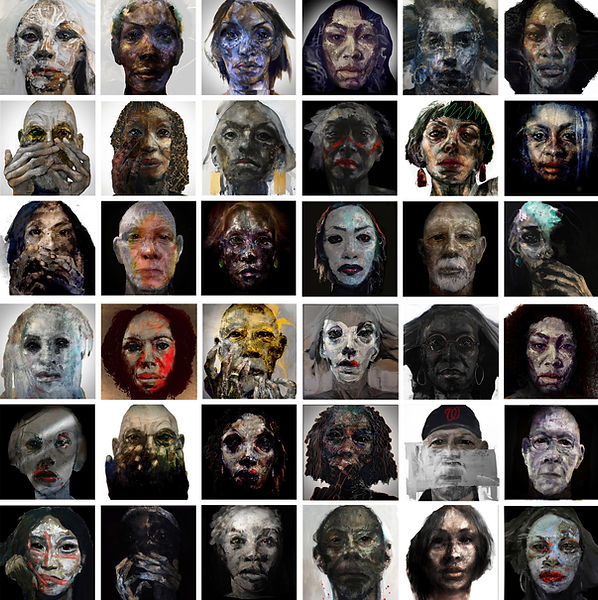
Visitors will enter through large-scale seven-foot portraits and move into an environment surrounded by closely spaced, illuminated smaller portraits whose identities and stories remain deliberately ambiguous. The density is intentional: one face is someone’s story, many faces are many people’s stories and together they become our story. The narrative moves from "them" to "us".
Using Visual Thinking Strategies VTS (see Appendix B), visitors will be invited to look closely and ask:
What’s going on in this picture? What do you see that makes you say that? What more can we find?
The experience then turns the questions toward the viewer:
What assumptions or biases did you bring to what you saw?
Visitors can add their observations to a public response wall that evolves throughout the festival, making their interpretations part of the installation itself. Artist conversations, facilitated VTS discussions and community programming will periodically turn the storefront into a gathering place for conversation and exchange.
The project grew from William Stoehr’s Art for Hope initiative addressing stigma surrounding substance use disorder and other experiences that are often similarly stigmatized, but the experience begins with something much more universal: how we see another human being and the assumptions we make, the biases we carry and the stories we construct.
Before knowing anything about the person before us, we may already be constructing a narrative based upon expression, appearance and our own memories and experiences.
Film and The Faces We Carry both concern human stories but they approach storytelling from opposite directions. The Faces We Carry asks what happens before the story is told.
Film typically gives us narrative, character and context. These portraits deliberately withhold them. The viewer supplies the story.
The portraits are not illustrations of people with a stigmatized condition. They intentionally resist categorization. That distinction is central to the project.
The question is not, for instance:
Who among these people has a substance use disorder?
The question is:
Why do we think we can tell?
The installation creates an opportunity to recognize the assumptions and biases viewers may bring to an encounter with another person.
The installation does not prescribe what visitors should feel, nor does it claim that encountering art alone will reduce stigma. Instead, it makes our interpretations visible and discussable.
Through the portraits, VTS conversations and the collective responses, the project creates an opportunity to encounter different ways of seeing, question initial assumptions and normalize conversations about experiences too often associated with “other people.”
Ultimately, the project asks whether looking more carefully while exploring our own assumptions, might change the way we see another person.
A modular pop-up installation
The installation is specifically designed to be adaptable to the architecture and dimensions of the vacant commercial space made available by the program.
Two or four large seven-foot portraits and an 85 inch digital monitor would establish the experience near the entrance. Beyond them, a flexible number (16 - 24) 28x28 inch portraits would be arranged on temporary side walls. The number of portraits can expand or contract according to the available space.
The response whiteboards, VTS prompts, exhibit information and programming can similarly be adapted to the space along the back wall.
The installation is intentionally modular and can be adapted to spaces ranging from smaller storefronts to substantially larger commercial spaces. The number of large paintings, illuminated portraits and temporary display walls can expand or contract according to the space available.
A larger space, approximately 2,000 to 3,000 square feet, would allow the installation to achieve its fullest immersive configuration and accommodate additional programming, but is not required for the project to succeed.
Temporary freestanding walls on wheels will be used to display portraits. They require no attachment to existing walls or floors and can be removed cleanly at the conclusion of the exhibition. They can also be configured to define the exhibition area within a space larger than required.
Here is a possible floor plan featuring six double-sided portrait walls holding 24 portraits on the front and back sides with 2 - 4 large portraits and an 85 inch digital monitor in the front.

Programming and participation
Throughout the activation, facilitated VTS sessions with Waverly Matthews and conversations with William Stoehr will transform the installation from a contemplative visual environment into a lively gathering place for conversation and exchange. An evolving visitor response wall will create a new collective conversation each day, while illuminated portraits visible through storefront windows can extend the installation into the street after hours.
The Faces We Carry -The Art of Seeing is designed to be immediately accessible to both Boulder community members and international visitors. No prior knowledge of contemporary art, Visual Thinking Strategies or the social issues underlying the work is required. The experience begins with something universal: looking at another human face. Large paintings and illuminated portraits create an immediate visual encounter, while a simple question provides an entry point across differences in language, culture, age and familiarity with art: When we look at another person, what do we see and what do we bring to that act of seeing?
Visitors can experience the installation in their own way and at their own pace. They may simply walk through and look, spend time with individual portraits, participate in a facilitated VTS conversation, or contribute anonymously to the evolving public response wall. The VTS questions use clear, open-ended language and require no specialized vocabulary or art expertise. The response wall allows visitors to encounter perspectives different from their own and makes the audience itself part of the installation.
The storefront setting further lowers the threshold for participation. Free public access, visible illuminated portraits, clear signage and an intuitive path through the installation invite people who might not ordinarily enter a gallery or museum.
The Faces We Carry - The Art of Seeing reflects Boulder’s diversity by centering a universal human experience: how we see and make assumptions about one another, while specifically addressing the stigma that can marginalize people.
The portraits depict women and men of different races and backgrounds at the same scale and with the same visual intensity. Their identities and circumstances are intentionally left ambiguous. Rather than assigning people to categories, the installation asks visitors to recognize how quickly we create those categories ourselves.
Community participation is central to the work. Visual Thinking Strategies (VTS), facilitated conversations and an evolving public response wall invite visitors to contribute their own observations, interpretations and experiences. No prior knowledge of contemporary art is required, and there is no “correct” interpretation. This creates multiple ways to participate from simply encountering the portraits to joining a conversation or adding a response anonymously.
The project is particularly intended to welcome people whose experiences are often absent from or stigmatized within, traditional cultural spaces. By locating the installation in a downtown storefront rather than a conventional gallery, offering free public access and creating opportunities for people to add their own voices to the work, the activation lowers some of the barriers between artist, artwork and audience. The goal is not to speak for underrepresented communities, but to create a space in which more people can speak for themselves and in which all of us can examine the assumptions we bring to seeing one another.
Community partnership and feasibility
The Faces We Carry - The Art of Seeing is a partnership between Off Broadway Arts at Pine Street Church with curator Waverley Matthews and artist William Stoehr. (see Appendix C)
This partnership roots the project within Boulder’s arts community while providing the practical support necessary for sustained public activation throughout the festival.
Stoehr has extensive experience creating large-scale art installations in galleries, universities, healthcare institutions and other public and non-traditional environments.
Stoehr also has substantial experience creating pop-up exhibitions, transforming nontraditional spaces including a warehouse, a church and an entire Pearl Street retail space into temporary galleries.
His projects have included collaborations and exhibitions involving the National Institute on Drug Abuse, Johns Hopkins University, the University of Colorado Anschutz Medical Campus, the University of Wisconsin Stout and other healthcare and educational institutions.
Stoehr’s existing body of large paintings and digital-hybrid images means that B-Sides funding can be directed primarily toward creating the experience. (see Appendix D)
Off Broadway Arts at Pine Street Church with curator Waverly Matthews, brings substantial experience producing multidisciplinary arts experiences that combine visual art, theater, music, education and community engagement. Its capabilities include theatrical production, artist coordination, installation, lighting, sound, staging, audience management and public programming, as well as transforming nontraditional spaces into engaging environments that encourage participation and dialogue.
Off Broadway Arts has previously collaborated with William Stoehr on programming combining his artwork with discussions on stigma and mental health. For The Faces We Carry - The Art of Seeing, it would serve as an experienced Boulder-based production and community partner, assisting with planning, installation and deinstallation, staffing, visitor engagement and public programming throughout the festival.
Attendance and Operations
The installation will operate within the B-Sides maximum occupancy requirement of 49 visitors at any one time. Off Broadway Arts staffing will assist with visitor flow, engagement and occupancy management.
Visitor impact and evaluation
The objective is not to tell visitors what they should see or feel.
It is to create circumstances in which they can become more conscious of how they see and how biases and assumptions may influence their judgements..
Visual Thinking Strategies encourages close observation and asks participants to identify the visual evidence supporting their interpretations.
Project evaluation will include estimated attendance, participation in scheduled programming, response-whiteboard wall participation, qualitative visitor responses and sales.
The evolving response boards will provide an anonymous record of how visitors interpret the portraits and whether their interpretations change after engaging with the project.
And in the end
We do not to claim that the installation itself will reduce stigma. Instead, we believe that it normalizes the discussion and creates an opportunity for visitors to recognize assumptions, encounter alternative interpretations and reflect on their responses.
We all construct stories about people before we know their stories. But we need to ask, "What did we bring to what we saw?"
Appendix B
Visual Thinking Strategies (VTS)
Visual Thinking Strategies (VTS) is a structured, discussion-based method for looking closely at visual art. It uses open-ended questions to help participants observe carefully, articulate what they see, support interpretations with visual evidence, listen to others, and reconsider their initial assumptions.
Rather than telling viewers what an artwork means, the viewer is asked three core questions:
What’s going on in this picture?
What do you see that makes you say that?
What more can we find?
Because of the nature of Stoehr’s art, we add another question which takes VTS to a new level.
What assumptions or biases did you bring to what you saw?
Why VTS matters
VTS develops critical thinking skills through careful observation, evidence-based reasoning, tolerance of uncertainty, perspective-taking and self-awareness.
VTS makes the process of interpretation visible. Participants discover that two people can look at the same image, notice different things, and construct different stories from what they see. They are encouraged to distinguish between what they actually observe and what they infer from those observations.
That makes VTS particularly relevant to Stoehr’s art. The same habits involved in looking at ambiguous art—careful observation, tolerance of uncertainty, evidence-based interpretation, awareness of assumptions, and consideration of alternative perspectives - can be applied to encounters with other individuals.
For Stoehr’s work, we take VTS even further: Look. Interpret. Explain what you see. Listen to what others see. Then look again.
That last step is especially important to The Faces We Carry. Stoehr’s ambiguous portraits could make VTS not simply an exercise in looking at art, but an exercise in recognizing how quickly we construct a story about another person before knowing their story.
Appendix C
About Off Broadway Arts at Pine Street Church
Pine Street Church has long held that art is a powerful path to reflection, personal growth and deeper understanding. Long before written language, people used images, music, dance and performance to express what moved them and what their communities valued.
Off Broadway Arts, a central ministry of Pine Street Church, carries that tradition forward through exhibitions, theater, concerts, film, education and community programming. Its stated purpose is to use the visual and performing arts to foster creativity, reflection, personal growth and community dialogue, to “expand consciousness, creativity and wisdom through vital experiences with the arts.”
Of particular relevance to The Faces We Carry, Off Broadway Arts frequently connects artistic experiences with difficult social and health issues, using art to challenge generalizations, misunderstandings and prejudices that can separate people. It functions as a community arts laboratory where visual art, theater, music, education and social issues can intersect.
This makes Off Broadway Arts a natural partner for a project that asks viewers to look more carefully, examine their assumptions, encounter different perspectives and reconsider how they see another person.
About William Stoehr
William Stoehr’s art explores the stigma associated with substance use disorder and experiences that are often similarly stigmatized, including mental health challenges, HIV/AIDS and incarceration. Stigma can become a barrier to prevention, diagnosis, treatment and recovery. It can alter how we see others and how we see ourselves. The faces he paints represent not only those directly affected, but also families, friends, caregivers, witnesses and communities.
Exhibited internationally at universities, art centers, museums and galleries, he has participated in more than 120 exhibits including more than 30 one-person exhibitions and has been recognized many times including several best of show awards.
His art and mission have received considerable national and international media coverage including NPR Morning Edition, NPR Atlanta City Lights, BBC, ABC/Scripps and the Associated Press plus many more publications, TV broadcasts, podcasts and interviews.
Appendix D
About the art
Stoehr paints both with traditional acrylic on canvas and digitally on his iPad.
Every portrait begins with a single face, an ambiguous expression, a direct shared gaze, an uncertain context and a few naturalistic cues. Accidents and experiments are central to his process.
Stoehr’s digital-hybrid paintings blur the boundaries between traditional painting, drawing, photography and digital media. Each begins with a high-resolution image repurposed from one of his own unfinished acrylic-on-canvas paintings. Working on an iPad and in Photoshop, he draws, layers, masks, erases and manipulates the image, transforming the original painting into an entirely new work created by his hand.
The finished works move freely between media - displayed as illuminated images, projected at architectural scale or printed on aluminum and other surfaces - challenging distinctions between painting, photography, digital image and installation.
The work connects the basic theory behind Cubism with the science of visual perception. Stoehr begins with the idea that seeing is an act of construction: the brain interprets what we see through memory, expectation, emotion and experience. By leaving the human face fragmented and unresolved, he asks viewers to complete it themselves.
What emerges belongs partly to the painting itself and partly to you - the beholder. This ambiguity raises a larger question at the center of his work - when we look at another person or portrait, how much are we seeing them and how much are we seeing ourselves?
The viewer becomes part of the medium.
The following is a selection of 28 × 28 inch portraits for the side walls. You can view a complete selection of potential large scale portraits for the entry area here.
The final selection and number of portraits will be determined by the size and configuration of the space.